
Amazons | The Legendary Warrior Women of Greek Mythology

Author
George | The Shiny Greece Team
The Amazons are among the most fascinating figures of Greek mythology: a legendary society of formidable warrior women who lived beyond the familiar boundaries of the ancient Greek world. Celebrated for their courage, independence, horsemanship, and skill in battle, they appear in myths involving some of Greece’s greatest heroes, including Heracles, Theseus, and Achilles.

Amazon at the Numismatic Museum of Athens | Photo by: George E. Koronaios, Mattei-type Amazon at the Numismatic Museum of Athens on October 1, 2021, cropped by Shiny Greece, CC BY-SA 4.0
Their stories move between myth and possible historical inspiration, connecting the Black Sea, Asia Minor, Athens, Troy, and the wider ancient world. From Queen Hippolyta and Antiope to the tragic Penthesilea, the Amazons became enduring symbols of female strength and a compelling reflection of how the ancient Greeks imagined societies radically different from their own.
Who Were the Amazons in Greek Mythology?
In Greek mythology, the Amazons were warrior women traditionally placed on the distant edges of the known world. Ancient writers did not always agree on precisely where they lived. Their homeland was variously associated with the region around the Black Sea, the river Thermodon in northern Anatolia, the Caucasus, and territories farther east.
The Amazons were not simply isolated mythical characters. They were imagined as members of an organized society, with queens, armies, cities, traditions, and military campaigns. Their defining characteristic was the independence from the conventional social order familiar to ancient Greek audiences.
A Society of Warrior Women
Greek accounts frequently presented the Amazons as expert fighters, particularly accomplished in archery, spear combat, and horsemanship. Ancient art often depicts them carrying bows, spears, shields, and battle axes or fighting from horseback.

Amazon on Attic Vase | Photo by: Aison (Hahland); perhaps Shuvalov Painter (Diepolder), Amazone Staatliche Antikensammlungen 2342, cropped by Shiny Greece, CC BY-SA 4.0
The very concept of such a society challenged the gender expectations of much of the ancient Greek world. Women in cities generally did not participate as warriors in public military life. The Amazons therefore represented an inversion of the familiar social order: women who ruled, fought, travelled, and confronted male heroes as equals on the battlefield.
Yet Greek mythology rarely portrayed them as weak opponents destined merely to be defeated. Their importance depended on precisely the opposite. Heroes gained prestige by confronting Amazons because these women were imagined as exceptionally dangerous warriors.
Where Did the Amazons Live?
One of the mysteries surrounding the Amazons is the location of their legendary homeland.
Many ancient traditions placed them near the Thermodon River and the Black Sea, particularly around Themiscyra, a settlement associated with the Amazons in classical literature. Other traditions moved them farther east or connected their campaigns with Asia Minor and regions surrounding the Aegean Sea.
This changing geography was typical of Greek mythology. Distant peoples and extraordinary creatures were frequently situated beyond borders of the world most familiar to Greek audiences.
From the Black Sea to Asia Minor
The geography associated with the Amazons also reflects the expanding knowledge of ancient Greek travellers, merchants, settlers, historians. As Greek colonies and commercial networks developed around the Black Sea, Greeks encountered peoples whose lifestyles differed significantly from those of communities in mainland Greece.

The Battle of the Amazons | Photo by: Peter Paul Rubens artist QS:P170,Q5599, Peter Paul Rubens - The Battle of the Amazons, marked as public domain, more details on Wikimedia Commons
This has contributed to one of the most intriguing questions surrounding the myth: could encounters with real warrior women have influenced Greek stories about the Amazons?
Amazons and the Great Heroes of Ancient Greece
The Amazons occupy an important position in heroic mythology because their stories repeatedly intersect with some of its most celebrated figures.
Their battles were not minor adventures. They became part of the legendary biographies of Heracles, Theseus, and Achilles, placing Amazon queens at the heart of several major Greek mythical cycles.
Heracles and Hippolyta, Queen of the Amazons
One of the best-known Amazon stories appears among the Labours of Heracles.
Heracles was ordered to obtain the belt of Hippolyta, queen of the Amazons. The belt was a symbol of her authority and had reportedly been given to her by Ares, the Greek god of war.
The Quest for Hippolyta’s Belt
According to some versions of the myth, Hippolyta initially welcomed Heracles and was willing to give him the belt. The situation changed after the intervention of Hera, the goddess whose hostility toward Heracles drives many episodes of his mythology.
Disguised among the Amazons, Hera reportedly spread the rumour that Heracles intended to abduct their queen. Fighting followed, and Hippolyta was killed in several versions of the story.
As with many ancient Greek myths, there was no single universally accepted narrative. Different writers preserved different versions, demonstrating how myths changed as they were retold across centuries.
The encounter nevertheless became one of the defining episodes connecting Heracles with the Amazons.
Theseus, Antiope and the Amazons in Athens
The Amazons were also connected with Theseus, the legendary hero and king associated with Athens.

Greek Warrior fighting an Amazon | Photo by: Sailko, Produzione greca o magnogreca, sarcofago delle amazzoni, 350-325 a.C. ca, da tarquinia 05, CC BY-SA 3.0
The central figure in this tradition is usually Antiope, although some versions identify the Amazon involved as Hippolyta. Ancient sources differ about whether Theseus abducted Antiope, received her as a companion, or encountered her under different circumstances.
Their story eventually leads to one of the most dramatic mythical events associated with ancient Athens: an Amazon invasion of Attica.
The Amazonomachy: Battle for Athens
The legendary conflict between Greeks and Amazons became known as an Amazonomachy. In the Athenian tradition, an Amazon army invaded Attica and reached Athens itself.
For ancient Athenians, the story acquired significance beyond mythology. Defeat of the Amazons could symbolize the restoration of the social and political order represented by the city.
Scenes of Amazonomachy appeared prominently in Greek art and architecture. They belonged to a broader visual language in which mythical battles represented conflicts between opposing worlds.
Visitors exploring the heritage of Athens today encounter a landscape filled with monuments associated with the myths, religion, politics, and artistic achievements of Ancient Greece. Stories such as the Amazon invasion formed part of the cultural imagination that surrounded this historic city.
Penthesilea and Achilles at the Trojan War
Perhaps the most moving Amazon story concerns Penthesilea, an Amazon queen who came to assist the Trojans during the Trojan War.
Penthesilea was presented as a powerful warrior who arrived at Troy after the death of Hector. Accompanied by other Amazons, she entered a battle against the Greeks and demonstrated extraordinary courage.
Her greatest opponent was Achilles.
The Tragic Duel of Achilles and Penthesilea
Achilles killed Penthesilea in combat. Later literary traditions transformed their confrontation into something far more emotionally complex than an ordinary battlefield victory.
According to a famous version of the story, Achilles saw Penthesilea after delivering the fatal blow and was overwhelmed by her beauty and courage. The episode became a tragic encounter between two exceptional warriors destined to meet as enemies.
Penthesilea consequently became one of the most memorable female figures connected with the Trojan cycle.
The story also reveals an important aspect of the Amazons in Greek mythology: admiration and fear could coexist. The Amazon warrior could be an enemy while simultaneously possessing qualities the Greeks associated with heroic greatness.
Amazons, Ares and the Gods of Olympus
The Amazons were closely associated with Ares, god of war and one of the major Olympian gods. Several traditions described them as daughters or descendants of Ares, reinforcing their identity as a warrior people.

Caryatid Amazon | Photo by: Aleksandr Zykov from Russia, Archaeological museum, Athens (4976609478), cropped by Shiny Greece, CC BY-SA 2.0
Their mythology also connects with other divine figures, e.g. Artemis, whose independence, hunting skills, and existence outside conventional domestic life made her particularly compatible with Amazon traditions.
Why Ares Matters to the Amazon Myth
Ares embodied the violent and unpredictable dimensions of warfare. Therefore, connecting the Amazons with Ares provided them with a divine military ancestry.
The relationship also explains the symbolic importance of Hippolyta’s belt. It was not merely an attractive possession sought by Heracles; as a gift from Ares, it represented royal and martial authority.
Through such connections, the Amazons became integrated into the wider religious and mythological world of Ancient Greece, rather than existing as a completely separate legend.
How Greek Art Portrayed the Amazons
The Amazons became enormously popular subjects in ancient Greek art. They appeared on painted pottery, sculptures, reliefs, temples, and monumental architectural decoration.
Artists frequently represented battles between Greeks and Amazons, allowing viewers to identify individual warriors through their weapons, clothing, and poses.
Amazonomachy in Ancient Greek Art
Amazonomachy scenes were significant because they created dramatic compositions filled with movement. Greek heroes could be shown fighting mounted or standing Amazon warriors in closely contested battles.
Representations appeared in important artistic contexts, including monuments connected with Athens and other centres of the ancient Greek world.
The subject continued to influence later Roman art and subsequently European painters and sculptors. Over time, the image of the Amazon warrior became detached from individual Greek myths and developed into a broader cultural symbol of a powerful female fighter.
Were the Amazons Real?
For centuries, the Amazons were treated primarily as creatures of mythology. Archaeology, however, has made the question of their possible historical inspiration much more interesting.
Excavations of ancient nomadic cultures across the Eurasian steppe have uncovered graves of women buried with weapons. Some remains also show evidence consistent with horseback riding and physical trauma.

Armed Amazon | Photo by: Euphronios, Amazone Staatliche Antikensammlungen 8953, marked as public domain, more details on Wikimedia Commons
Such discoveries do not prove that the Amazon society described by Greek mythology existed exactly as ancient storytellers imagined it. They do, however, demonstrate that armed women were not necessarily imaginary in cultures encountered or known indirectly by the Greeks.
Scythian Women and the Amazon Legend
The Scythians, famous for their equestrian culture and skills in warfare, are discussed in relation to the historical origins of Amazon stories.
Greek communities around the Black Sea had opportunities for contact with Scythian and other steppe peoples. Women participating in riding, hunting, or warfare could have appeared strikingly different from the gender roles familiar to many Greeks.
The mythology of the Amazons may therefore contain distant echoes of genuine cultural encounters, transformed through generations of storytelling.
That possibility makes the legend especially compelling. The Amazons stand at the intersection of mythology, ancient geography, archaeology, and cultural memory.
What the Amazons Symbolized to the Ancient Greeks
Understanding the Amazons requires looking beyond the question of whether they existed. They represented an alternative world.
Greek mythology frequently explored order through its opposite. Civilized landscapes were contrasted with wilderness; mortals confronted monsters; cities faced outsiders; familiar customs were measured against societies imagined at the edges of the known world.
The Amazons fitted perfectly into this pattern.
Strength, Independence and the Reversal of Greek Society
Their society reversed traditional expectations. Women became warriors and rulers. They rode horses, travelled across enormous distances, commanded armies, and challenged legendary male heroes.
Yet the stories also reveal considerable admiration for them. Hippolyta possessed royal authority. Penthesilea demonstrated heroic bravery. Antiope became central to the mythology of Theseus.

Helmet of Roman Horsemen | Photo by: TimeTravelRome, Bronze parade helmet with the face of Amazon from Nola 100-200 AD (51234442230), CC BY 2.0
The Amazons therefore cannot be reduced simply to villains. They were opponents worthy of heroes.
That ambiguity is one reason they have remained so compelling for more than two millennia.
Famous Amazon Queens of Greek Mythology
Although ancient sources name numerous Amazons, several became particularly important.
Hippolyta is remembered above all through Heracles and the quest for her belt. Antiope became connected with Theseus and the legendary Amazon attack on Athens. Penthesilea entered the mythology of the Trojan War through her fatal encounter with Achilles.
Other named Amazons appear across Greek literature and artistic traditions. This fact created the impression of a much larger legendary community rather than a handful of isolated characters.
Their stories link different parts of the Greek mythical universe: Mount Olympus and the gods, Athens and its legendary kings, Heracles and his Labours, Troy and the Trojan War, the Black Sea and the distant lands explored by the ancient Greeks.
The Enduring Legacy of the Amazons
Few figures from Greek mythology have adapted so successfully to different periods and cultures.
The word “Amazon” itself eventually came to describe a strong or formidable woman. Amazon warriors appeared repeatedly in Renaissance and later European art, literature, theatre, popular fiction, comics, cinema, and modern interpretations of classical mythology.
Their longevity is not difficult to understand. The Amazons combine adventure, mystery, warfare, cultural difference, and questions about power and gender in stories involving some of the greatest personalities of Greek mythology.
They also belong to the extraordinary imaginary geography created by the ancient Greeks - a world stretching from Crete, Delphi, Olympia, Sparta, and Athens to the Aegean islands, Asia Minor, Troy, and the distant shores of the Black Sea.
Why the Amazons Still Fascinate the World
The Amazons occupy a unique place between legend and history. Greek mythology transformed them into fearless warriors who challenged Heracles, Theseus, Achilles, and the conventions of the ancient world, while archaeology has shown that women capable of riding and fighting were not purely products of imagination.
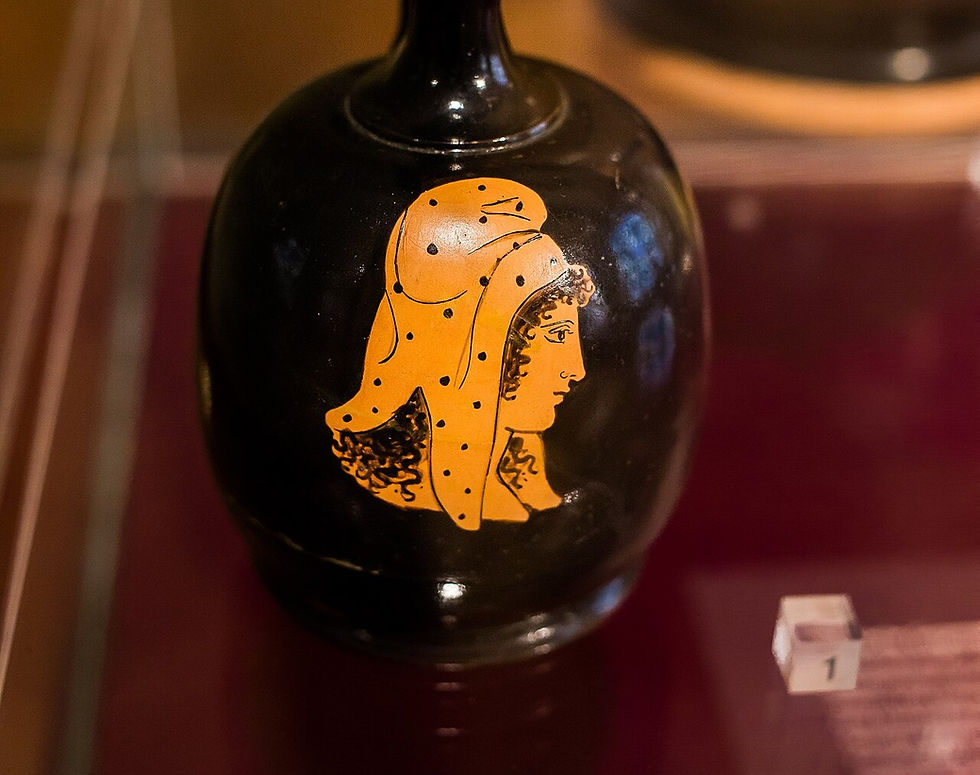
Lekythos with Amazon Head | Photo by: ArchaiOptix, Achilles Painter ARV 994 109ter head of amazon wearing a Scythian cap, cropped by Shiny Greece, CC BY-SA 4.0
Hippolyta, Antiope, and Penthesilea remain memorable because their stories are about far more than battles. They explore courage, authority, cultural difference, tragedy, and boundaries between the familiar and the unknown.
For anyone discovering Greek mythology, Ancient Greece, or the history behind Greece’s archaeological sites and museums, the Amazons offer a fascinating reminder that mythology was never merely a collection of fantastic tales. It was one of the ways the ancient Greeks interpreted their world - and imagined the extraordinary worlds beyond it.


Comments