
Homer | Ancient Greek Poet | The Legendary Influencer who Defined Western Literature

Updated: Aug 16
Authors
George | The Shiny Greece Team
When it comes to the origins of Western literature, there is no figure more prominent than the legendary Greek poet Homer. Despite the fact that little is known about his life, Homer's epics - The Iliad and The Odyssey - have been studied and revered for over two thousand years, shaping the course of literature and Western culture as a whole. In this article, we explore the life and work of Homer, his influence on literature, and the ongoing debates surrounding his identity.

Idealized portrayal of Homer dating to the Hellenistic period, British Museum | Photo by: in the public domain (according to Wikimedia Commons)
Life and Work of Homer
The identity of Homer has been the subject of much debate among scholars for centuries. The most commonly held belief is that Homer was a blind poet who lived in Greece during the eighth century BCE. According to tradition, Homer was born in the city of Smyrna and later migrated to Chios, where he composed his two epic poems. The Iliad and The Odyssey are epic poems that tell the stories of the Trojan War and the adventures of the Greek hero Odysseus, respectively. These poems are written in dactylic hexameter, a form of metered poetry that was common in ancient Greek literature. The Iliad focuses on the wrath of Achilles, a Greek warrior who refuses to fight after being slighted by his king, while The Odyssey follows Odysseus on his ten-year journey home after the Trojan War.
Influence on Literature
Homer's impact on Western literature cannot be overstated. His works have been studied and analyzed for centuries, and have served as the basis for countless adaptations and interpretations. The Iliad and The Odyssey have influenced writers ranging from Virgil and Dante to Shakespeare and James Joyce.
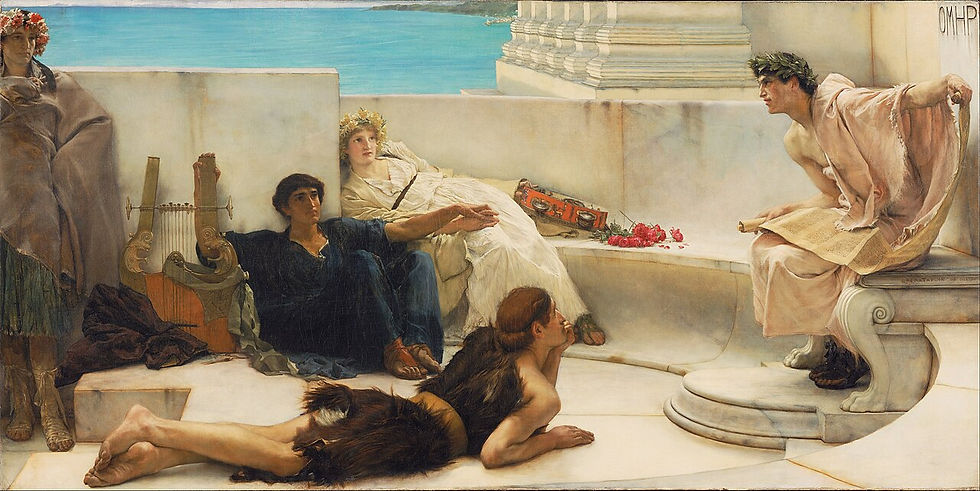
A Reading from Homer | Photo by: Lawrence Alma-Tadema artist QS:P170,Q240526 Google Art Projectでのアーティストの詳細, Sir Lawrence Alma-Tadema, English (born Netherlands) - A Reading from Homer - Google Art Project, marked as public domain, more details on Wikimedia Commons
In addition to their literary value, Homer's epics are also considered to be important historical documents. The Iliad, in particular, offers a vivid portrayal of life in ancient Greece, providing insight into everything from the society's social structures to its military tactics.
Homer's Identity Debate
The main question on Homer - by whom, when, where and under what circumstances were the Iliad and Odyssey composed - continues to be debated. Maybe in the island of the mastic? One group holds that most of Iliad and the Odyssey is the works of a single poet of genius.

Homer and His Guide | Photo by: William-Adolphe Bouguereau artist QS:P170,Q483992, William-Adolphe Bouguereau (1825-1905) - Homer and his Guide (1874), marked as public domain, more details on Wikimedia Commons
Despite this widespread belief, there is evidence to suggest that the Iliad and The Odyssey were actually the work of multiple authors, the crystallization of a process of working and re-working by many contributors and that "Homer", among other famous Greek poets like Sappho, is best seen as a label for an entire tradition. Some scholars have pointed out discrepancies in style and content between the two epics, leading them to conclude that they were written by different poets. Others have questioned whether Homer even existed at all. This theory, known as the "Homeric Question," remains a topic of debate among scholars to this day.
Shaping History
Homer's legacy as a poet and storyteller continues to inspire and captivate readers today, more than two thousand years after his death. His epic poems, The Iliad and The Odyssey, remain among the most revered works of Western literature, and his huge influence can be seen in everything from Shakespearean drama to modern-day film adaptations, music and visual art. Despite the ongoing debates surrounding his identity, there is no denying the lasting impact that Homer has had on literature and Western culture as a whole. His work has helped to shape the course of history, and his stories continue to resonate with readers of all ages and backgrounds.
FAQs for Homer
Want to learn more about Homer, the legendary ancient Greek poet, and his timeless influence on world literature? Below you'll find answers to some of the most frequently asked questions about Homer the Greek poet, his life, his greatest works, and his lasting legacy in Ancient Greece. These FAQs are designed to provide useful information while helping readers better understand why Homer remains one of the most famous ancient Greek poets in history.
1. Who was Homer, the ancient Greek poet?
Homer was a legendary ancient Greek poet traditionally credited with composing the Iliad and the Odyssey. Although historians continue to debate his life and identity, he is widely regarded as the father of Western epic poetry.
2. Where was Homer from in Ancient Greece?
The exact birthplace of Homer is unknown. Several ancient Greek cities, including Smyrna (modern İzmir) and Chios, claimed him as their own. Because no historical records survive, his true origin remains uncertain.
3. What are Homer's most famous works?
Homer's most famous works are the Iliad and the Odyssey. The Iliad tells the story of the Trojan War, while the Odyssey follows Odysseus' adventurous journey home after the war.
4. What did Homer do in Ancient Greece?
Homer composed epic poems that preserved Greek myths, heroic traditions, and cultural values. His storytelling influenced education, philosophy, literature, and the arts throughout Ancient Greece and continues to shape Western culture today.
5. Where did Homer live?
Historians cannot determine exactly where Homer lived. Ancient traditions associate him with the eastern Aegean region, particularly the Ionian coast and nearby islands, but no definitive evidence exists.
6. Why is Homer considered one of the most famous Greek poets?
Homer is considered one of the most famous Greek poets because his epics established the foundations of Greek literature and inspired countless writers, historians, philosophers, and artists for nearly three thousand years.
7. Was Homer also a Greek writer?
Yes. Homer is often described as both a Greek poet and a Greek writer. Although his works originated in the oral storytelling tradition before being written down, they are among the earliest masterpieces of Greek literature.
8. What are some interesting facts about Homer?
Interesting facts about Homer include that historians are unsure whether he was a single person or several poets, many believe he was blind, and his poems were originally performed aloud by traveling bards rather than read from books.
9. What does Homer represent in Ancient Greek history?
In Ancient Greece, Homer represented the ideal storyteller whose epics preserved history, mythology, religion, heroism, and moral values. His poems became central texts in Greek education for centuries.
10. Who are the most famous ancient Greek poets besides Homer?
Besides Homer, some of the most famous ancient Greek poets include Hesiod, Sappho, Pindar, Archilochus, Alcaeus, Anacreon, and Theocritus, each making significant contributions to Greek literature and poetry.


Interesting debates on Homer.
One of the most influential authors of all times!!!