
Academy of Athens | Greece’s Premier Hub for Science, Philosophy, and Neoclassical Splendor

Updated: 6 days ago
Author
George | The Shiny Greece Team
The Academy of Athens, founded in 1926, is Greece’s premier research institution and embodies the nation’s commitment to the sciences, humanities, and the arts.

Academy of Athens | Photo by: C messier, Akadimia Athinon 1178, CC BY-SA 4.0
Known for its architectural splendor and cultural significance, this institution serves as both a research hub and a symbol of Greece’s intellectual heritage. Let’s explore its history, architectural features, role in modern scholarship, and cultural impact.
Foundation and Purpose
Academy of Athens History
The Academy of Athens was established to advance research and knowledge in Greece, echoing the spirit of Plato's ancient academy. Although rooted in tradition, this modern Academy took inspiration from other European academies of the 19th and 20th centuries, aiming to position Greece at the forefront of scholarly and scientific endeavors. With financial support from philanthropist Simon Sinas, the building was designed by Theophil Hansen and completed in 1885. It is part of the Athens Trilogy, which includes the University of Athens and the National Library of Greece, together symbolizing Greece’s cultural revival and dedication to education.
Objectives and Mission
The Academy’s founding goals focused on advancing the sciences, promoting philosophical discourse, and preserving Greek cultural heritage. Its mission continues today with active engagement in research and global academic collaboration. Through a structure of specialized research centers, the Academy promotes interdisciplinary studies across humanities, sciences, and arts. The institution also advises the Greek government on educational and cultural policies, strengthening its role as a guardian of intellectual traditions and scientific progress.

Pediment of the Academy of Athens | Photo by: Rabe!, Athen 2011-05-02zzc, CC BY-SA 4.0
Architectural Significance
Neoclassical Design
The Academy of Athens stands as an architectural masterpiece in neoclassical design, heavily influenced by ancient Greek monuments. Designed by Danish architect Theophil Hansen, its aesthetic is inspired by the Acropolis of Athens and other ancient structures, and was completed under the supervision of architect Ernst Ziller. The building features grand columns, elaborate friezes, and statues of key figures from Greek mythology, including Athena and Apollo, which symbolize wisdom and the arts, respectively.
Art and Decoration
The Academy’s interiors and exteriors reflect the skills of artists such as Leonidas Drossis and Christian Griepenkerl. Drossis sculpted the Academy’s intricate statues, while Griepenkerl’s paintings add depth to the building’s ceiling murals. These elements together create a space that celebrates Greek artistic heritage while embodying the ideals of knowledge and enlightenment. Today, the Academy building itself is a popular attraction for visitors, scholars, and art enthusiasts.

Detail of a Pillar of the Academy of Athens | Photo by: Jean Housen, 20211030 athenes144, CC BY-SA 4.0
Tour Offers for Athens
Divisions & Research Focus
Scientific & Humanities Divisions
The Academy of Athens is structured into three main divisions: Natural Sciences, Humanities and Arts, and Ethical and Political Sciences. Each division encompasses research centers and departments dedicated to topics such as biological sciences, archaeology, philosophy, and ethics. These divisions facilitate advanced research and foster collaboration with international institutions, solidifying the Academy’s reputation in the global academic community.
If you want to find out more about Athens and to get best advice for hotels, tours, restaurants, cafés, bars, monuments & beaches, visit our Athens Page!
Research Contributions
The Academy has made substantial contributions to fields like archaeology, Byzantine studies, and environmental science. One of its prestigious initiatives is the Research Center for Greek Philosophy, which explores ancient philosophical texts and their modern applications. Other centers focus on topics ranging from astronomy and atmospheric science to cultural studies, supporting Greece’s standing as a leader in both ancient and modern scholarship.

Hall of the Academy of Athens | Photo by: C messier, Akadimia Athinon 5242-1, CC BY-SA 4.0
Cultural & Educational Impact
Influence on Greek Society
The Academy of Athens plays a significant role in shaping Greece’s educational and cultural landscape. Through publications, seminars, and collaborations with universities worldwide, the Academy disseminates knowledge and encourages cultural preservation. It has also contributed to Greek national identity, fostering an appreciation for classical heritage and contemporary scientific inquiry.
Collaborations & Memberships
As a member of international organizations, such as the European Academy of Sciences and Humanities, the Academy of Athens enhances Greece's involvement in global scholarly networks. The Academy collaborates on projects addressing climate change, ethics in science, and global public health, highlighting its role in addressing contemporary global challenges.

Athens Academy | Photo by: Jean Housen, 20211030 athenes138, CC BY-SA 4.0
Academy of Athens in Modern Greece
Advising and Policy-Making
Beyond its research functions, the Academy frequently serves as an advisory body to the Greek government, offering insights on pressing national and global issues. It advises on educational reforms, heritage conservation, and environmental policy, helping align Greece’s public policies with scientific and cultural advancements.
Engagement & Outreach
The Academy organizes lectures, conferences, and educational programs that are open to the public. These events foster a greater appreciation of Greek history, philosophy, and the sciences, making the Academy an essential bridge between academia and society. Through these programs, the Academy educates citizens and nurtures the next generation of scholars.

Ceiling Detail of Athens Academy | Photo by: Niko Kitsakis, Academy of Athens Coffered Ceiling, cropped by Shiny Greece, CC BY 4.0
Monument to Greek Heritage
Symbolic and Cultural Value
The Academy of Athens is more than a research institution; it’s a cultural icon that connects Greece’s ancient past with its present. The building itself, an architectural homage to the Acropolis of Athens stands as a symbol of the continuity of Greek civilization and its dedication to knowledge. Statues of Athena and Apollo, central figures in Greek mythology, embody the Academy’s commitment to wisdom and creativity.
Preservation of Traditions
In a rapidly changing world, the Academy remains a custodian of Greek intellectual traditions, bridging the classical past with contemporary advancements. The institution’s commitment to preserving and advancing knowledge resonates deeply with Greek society, inspiring admiration and pride.
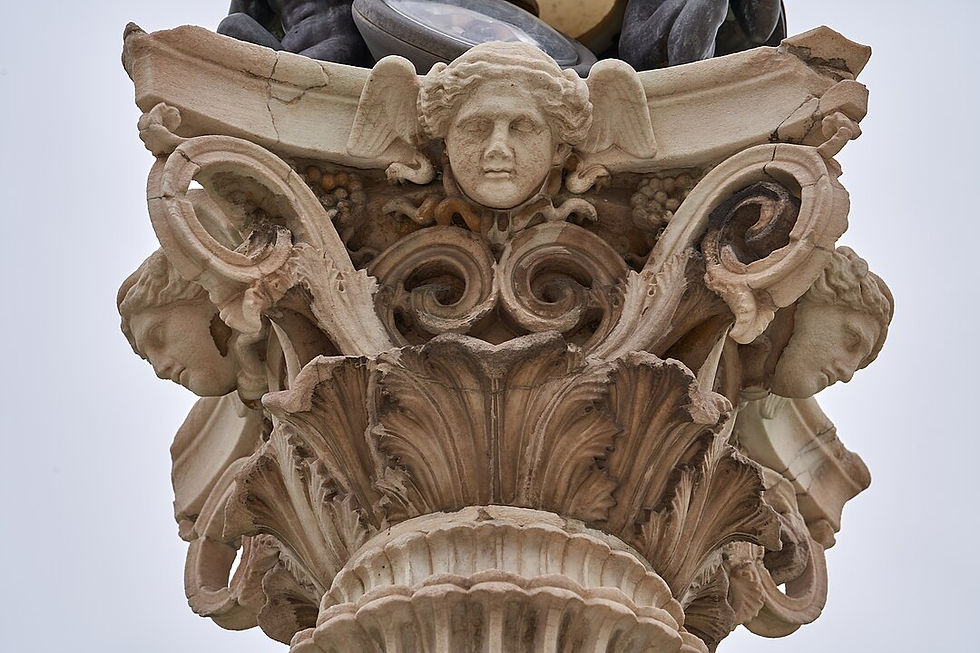
Athens Academy Detail of Lamp Post | Photo by: George E. Koronaios, Corinthian capital at the Academy of Athens on May 1, 2022, CC BY-SA 4.0
Legacy of the Academy of Athens
The Academy of Athens continues to be a pillar of Greek and international scholarship, representing Greece’s intellectual legacy while addressing modern issues. By fostering research, preserving cultural heritage, and engaging with the public, the Academy plays a vital role in the advancement of knowledge and society. Its neoclassical architecture and dedication to ancient ideals reflect an ongoing reverence for Greek heritage, positioning it as a bridge between the wisdom of the past and the challenges of the future.
In essence, the Academy of Athens stands as a testament to Greece’s enduring commitment to learning and cultural preservation, reflecting both a historic foundation and a forward-looking mission. Through its work, the Academy remains a guiding light for intellectual progress and cultural continuity, honoring its place in Greek society and the world. Among the distinguished scientists associated with the Academy is Stamatios Krimigis, the internationally renowned Greek-American space scientist whose career has been closely connected with major missions exploring the Solar System.
FAQs for the Academy of Athens
The Academy of Athens, also known as Akadimia Athinon, is Greece’s leading academy of sciences, humanities, and fine arts. From its impressive neoclassical architecture to its role in scientific research and Greek intellectual life, discover the most important facts about this landmark institution in Athens.
What is the Academy of Athens?
The Academy of Athens is Greece’s national academy dedicated to advancing the sciences, humanities, and fine arts. Founded in 1926, it promotes research, scholarship, intellectual collaboration, and the development and preservation of knowledge in Greece.
Is the Academy of Athens an academy of science?
Yes. The Academy of Athens functions as Greece’s national academy of science, while its scope also extends to the humanities and fine arts. Scientific research has been part of its mission since its establishment, and numerous specialized research centers operate under the Academy.
What does Akadimia Athinon mean?
Akadimia Athinon (Ακαδημία Αθηνών) is the Greek name for the Academy of Athens. “Akadimia” means academy, while “Athinon” means “of Athens.” The institution takes its name from Athens and recalls the intellectual tradition associated with Plato’s ancient Academy.
When was the Academy of Athens founded?
The Academy of Athens was officially founded on March 18, 1926, as an Academy of Sciences, Humanities and Fine Arts. Efforts to establish a national Greek academy had begun much earlier, with proposals dating back to the 19th century.
What does the Academy of Athens do?
The Academy of Athens promotes scientific and scholarly research, supports the humanities and fine arts, publishes academic work, participates in international research programs, and contributes to intellectual and cultural life in Greece. Its research centers cover fields ranging from philosophy and history to astronomy and climatology.
Is the Academy of Athens the national academy of Greece?
Yes. The Academy of Athens is the National Academy of Greece for the sciences, humanities, and fine arts. It occupies a central position in the country’s academic and intellectual landscape and maintains links with international scholarly and scientific organizations.
Who designed the Academy of Athens?
The Academy of Athens building was designed by Danish architect Theophil Hansen, one of the leading figures of 19th-century neoclassical architecture. Its construction was financed by benefactor Simon Sinas, while its elaborate sculptural decoration helped make it one of Athens’ most recognizable buildings.
Why is the Academy of Athens building famous?
The Academy of Athens is famous for its magnificent neoclassical architecture, monumental columns, sculptures, and references to ancient Greek art. Statues of Athena and Apollo dominate the exterior, reinforcing the building’s symbolic connection with wisdom, knowledge, music, and the arts.
Is the Academy of Athens connected to Plato’s Academy?
The modern Academy of Athens is not the same institution as Plato’s ancient Academy, but its name deliberately refers to Plato’s famous philosophical school and the intellectual heritage of ancient Athens. The modern Academy carries that tradition into contemporary scientific and scholarly research.
Where is the Academy of Athens located?
The Academy of Athens is located at 28 Panepistimiou Street in central Athens, Greece. Its celebrated neoclassical building forms part of the architectural ensemble commonly known as the Athenian Trilogy, together with the University of Athens and the National Library.


A beacon of wisdom!!
What a piece of art!!
An architectural masterpiece! A must-see for those interested in history and Greek culture!